
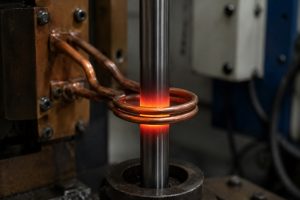
High-frequency induction hardening is an advanced surface heat treatment process designed to improve the surface hardness and wear resistance of metal components while maintaining the toughness and ductility of the core.
The process rapidly heats selected areas of a workpiece through electromagnetic induction, followed by immediate quenching and, when required, tempering.
Unlike conventional furnace heat treatment, induction hardening precisely targets only the required surface areas, minimizing thermal distortion while preserving the mechanical properties of the rest of the component. This makes it an ideal solution for precision-machined parts that require high surface hardness without sacrificing structural strength.
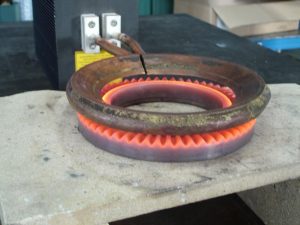
Induction hardening is commonly applied to medium-carbon steels (typically containing 0.35–0.60% carbon) and alloy steels, and is widely used for high-performance precision components such as shafts, gears, sprockets, rollers, cams, and cutting tools.
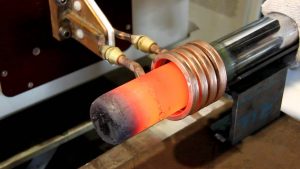
How High-Frequency Induction Hardening Works
The workpiece is positioned inside or adjacent to an induction coil carrying a high-frequency alternating current. The alternating magnetic field generates eddy currents within the surface of the metal, producing rapid localized heating.
The depth of heating depends largely on the operating frequency—the higher the frequency, the shallower the hardened layer. By precisely controlling the frequency, output power, and heating time, manufacturers can achieve consistent hardness, case depth, and dimensional accuracy.
Advantages
1. Rapid Heating
The workpiece surface reaches the target temperature within seconds, significantly improving production efficiency.
2. Minimal Distortion
Because only localized areas are heated, overall thermal distortion is minimized, helping maintain dimensional accuracy.
3. Precise Localized Hardening
Only critical wear surfaces are hardened, while the core remains tough and ductile.
4. Excellent Repeatability
Automated process control ensures consistent hardness and quality throughout production.
5. Improved Wear Resistance and Service Life
The hardened surface greatly increases resistance to wear, fatigue, and contact stress.
Limitations
1. Higher Initial Equipment Investment
Induction heating systems require specialized equipment and power supplies.
2. Custom Coil Design Required
Different part geometries often require dedicated induction coils, increasing tooling costs.
3. Not Suitable for Every Component
Parts with highly complex shapes or inaccessible surfaces may not be ideal candidates for induction hardening.
With its fast processing speed, precise localized heating, and minimal distortion, high-frequency induction hardening has become one of the most effective surface hardening technologies for precision-engineered components. Although the initial equipment investment is relatively high, the process delivers superior wear resistance, extended service life, and consistent product quality, making it a preferred solution for demanding industrial applications.
You can find the photo display of the CNC machining parts made by us HERE!