
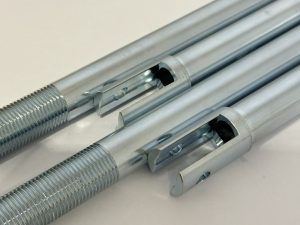
Many people believe that galvanized steel never rusts. In reality, both galvanized steel and zinc-plated steel can still develop corrosion over time. However, the appearance of rust does not always mean the protective coating has failed.
In most cases, corrosion on galvanized steel falls into two categories:
• White rust – a protective oxidation of zinc
• Red rust – corrosion of the underlying steel
Understanding the difference between these two types of corrosion helps determine whether the galvanized coating is still providing protection.
White Rust vs. Red Rust on Galvanized Steel
White Rust – A Natural Protective Process
When zinc is exposed to air and moisture, it reacts with oxygen and water to form zinc hydroxide, a white powdery substance commonly known as white rust. This is actually a normal oxidation process of the zinc coating. Over time, the white layer gradually converts into zinc carbonate, forming a thin and stable protective film known as zinc carbonate patina.
This protective layer has several important characteristics:
Dense and stable
Low water permeability
Strong adhesion to the zinc surface
Because of these properties, the patina layer significantly slows down further corrosion. In other words, a small amount of white rust often indicates that the galvanized coating is functioning as intended.
Red Rust – A Sign of Coating Failure
Red rust is the familiar reddish-brown iron oxide that forms when steel corrodes.
It typically appears when:
• The zinc coating has been completely consumed
• The protective layer has been damaged
Once this happens, the underlying steel begins to oxidize. Unlike the dense zinc patina, iron oxide is porous and loosely structured, which allows it to absorb moisture and accelerate corrosion.
The presence of red rust usually means:
The galvanized coating has lost its protective ability
The steel may begin to lose structural integrity
In such cases, repair, recoating, or replacement may be required.
Common Myths About Galvanized Steel
Myth 1: Galvanized Steel is Completely Rust-Proof
Reality: Galvanizing significantly slows corrosion, but it cannot prevent it forever. Zinc coatings have a finite thickness and will gradually be consumed over time.
The service life of galvanized steel depends mainly on:
• The thickness of the zinc coating
• The corrosiveness of the environment
Therefore, treating galvanizing as a permanent, maintenance-free solution is a common misconception.
Myth 2: All Galvanizing Processes Provide the Same Protection
Reality: Different galvanizing methods offer significantly different levels of protection. Two of the most common methods are:
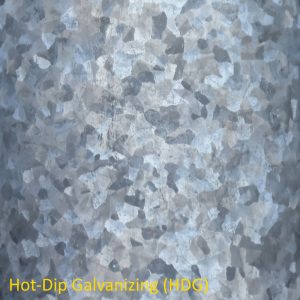
• Hot-Dip Galvanizing (HDG)
• Electroplated Zinc (Electrogalvanizing, EG)
These processes differ in terms of:
• Coating thickness
• Corrosion resistance
• Surface appearance
• Cost
For precision-machined components, electroplated zinc is often preferred due to its smooth appearance, controlled coating thickness, and compatibility with tight dimensional tolerances.
For applications requiring long-term outdoor corrosion protection, such as structural steel, outdoor infrastructure, or marine environments, hot-dip galvanizing is typically the more durable option.
Conclusion
Galvanizing remains one of the most effective corrosion protection methods for steel. However, understanding how it works—and its limitations—is essential when selecting the right coating process to ensure reliable performance, durability, and long-term value.
If you are sourcing custom metal components with zinc plating or other surface treatments, feel free to contact us for technical support or a quotation.
You can find the photo display of the CNC machining parts made by us HERE!